And would suffice.
dimanche 21 juin 2020
Frost : 'Feu et glace' [traduction M.P.]
And would suffice.
samedi 20 juin 2020
Sonnet de la boule Quiès
vendredi 19 juin 2020
Barrett-Browning : Sonnet portugais X [traduction M.P.]
Yet, love, mere love, is beautiful indeed
And worthy of acceptation. Fire is bright,
Let temple burn, or flax. An equal light
Leaps in the flame from cedar-plank or weed.
And love is fire ; and when I say at need
I love thee... mark ! I love thee !... in thy sight
I stand transfigured, glorified aright,
With conscience of the new rays that proceed
Out of my face toward thine. There's nothing low
In love, when love the lowest : meanest creatures
Who love God, God accepts while loving so.
And what I feel, across the inferior features
Of what I am, doth flash itself, and show
How that great work of Love enhances Nature's.
jeudi 18 juin 2020
Yeats : 'Death' [1929] [traduction M.P.]
MortUn animal mourantn'a d'espoir ni de peur.Sa fin, l'homme l'attend,tout espoirs et frayeurs.Plusieurs fois il est mort,et il s'est relevé.L'homme orgueilleux et fortface à ses meurtriersjette sa dérisionsur le souffle coupé :il sait la mort à fond -c'est lui qui l'a créée.
DeathNor dread nor hope attendA dying animal ;A man awaits his endDreading and hoping all ;Many times he died,Many times rose again.A great man in his prideConfronting murderous menCasts derision uponSupersession of breath ;He knows death to the bone -Man has created death.
mercredi 17 juin 2020
Yeats : 'When you are old...' [traduction M.P.]
[1892]When you are old and grey and full of sleep,And nodding by the fire, take down this book,And slowly read, and dream of the soft lookYour eyes had once, and of their shadows deep ;How many loved your moments of glad grace,And loved your beauty with love false or true,But one man loved the pilgrim soul in you,And loved the sorrows of your changing face.And bending down beside the glowing bars,Murmur, a little sadly, how Love fledAnd paced upon the mountains overheadAnd hid his face amid a crowd of stars.
mardi 16 juin 2020
Sonnet du Blaireau
lundi 15 juin 2020
Keats et échos (Allen et Nabokov)
dimanche 14 juin 2020
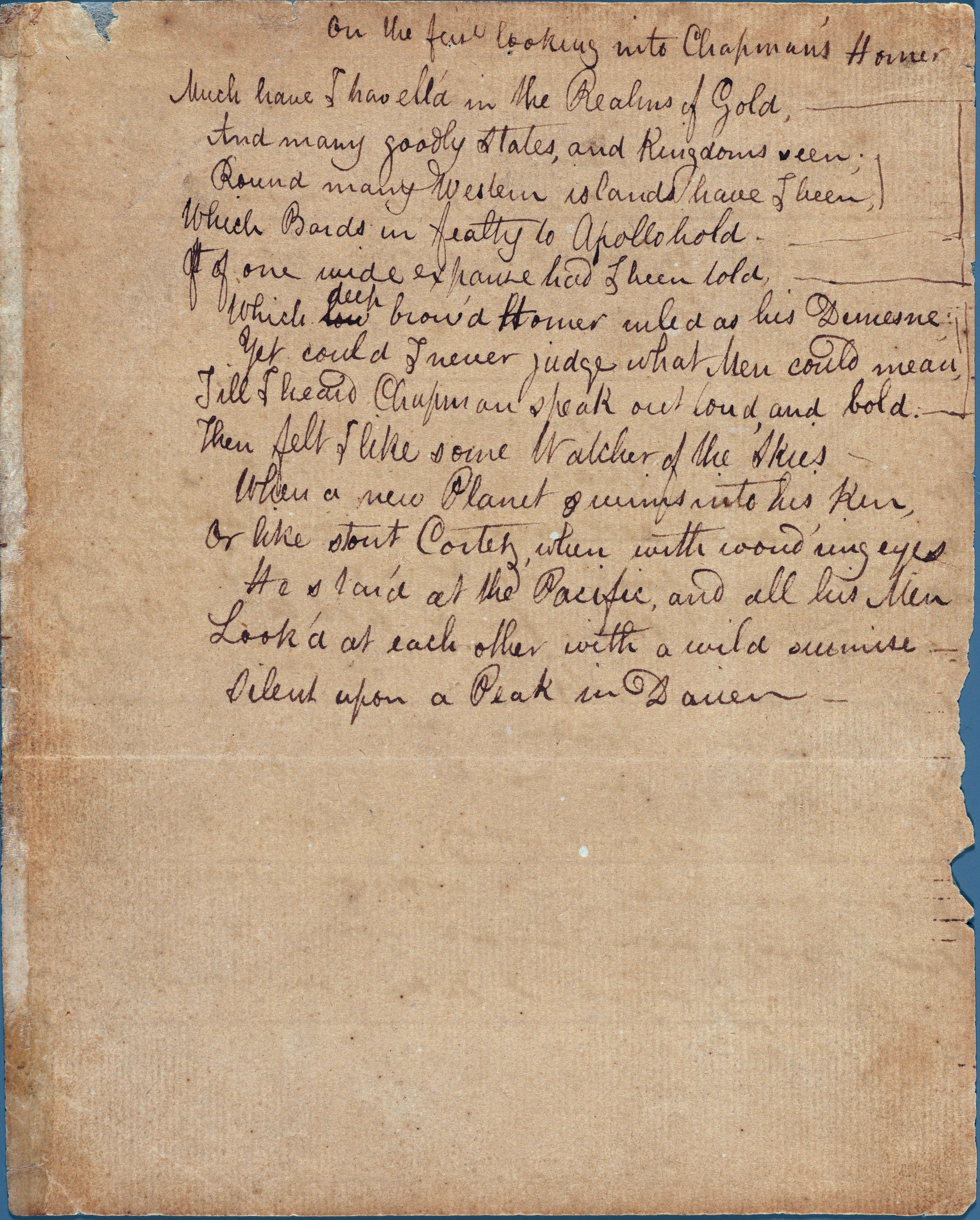
Keats : Sur l'Homère de Chapman [traduction M.P.]
Après un premier regard sur l’Homère de Chapman
J’ai parcouru l’or de bien des régions
Et vu bien des royaumes opulents
Contourné bien des îles d’occident
Où des bardes régnaient pour Apollon.
On m’avait dit ces étendues immenses,
Empires d’Homère au front souverain ;
Mais je n’ai respiré son air serein
Que grâce à Chapman et sa voix intense.
Je fus tel un guetteur qui dans les cieux
Rencontre un nouvel astre qui survient,
Tel que l’aigle Cortez quand de ses yeux
Il vit le Pacifique, et que les siens
Se regardaient, farouches, suspicieux,
En silence, sur un pic à Darien.
On First Looking into Chapman's Homer
« Much have I travell'd in the realms of gold,
And many goodly states and kingdoms seen ;
Round many western islands have I been
Which bards in fealty to Apollo hold.
Oft of one wide expanse had I been told
That deep-brow'd Homer ruled as his demesne ;
Yet did I never breathe its pure serene
Till I heard Chapman speak out loud and bold :
Then felt I like some watcher of the skies
When a new planet swims into his ken ;
Or like stout Cortez when with eagle eyes
He star'd at the Pacific—and all his men
Look'd at each other with a wild surmise—
Silent, upon a peak in Darien. »
Le manuscrit :
https://upload.wikimedia.org/wikipedia/commons/1/18/On_First_Looking_into_Chapman%27s_Homer.png
samedi 13 juin 2020
En Nabokov plusieurs personnages…
- nettement platonicien :
The Waltz invention p. 50 :
To My Soul
My Soul, how fierce is your impatience,
How gladly home you would have flown,
Out of the marvelously fashioned,
But much too narrow cage of bone !
Your home I do not know, believe me !
Even the way there, is not clear,
And when you fly, how shall I follow
With so much booty taken here?
[traduction M.P.]
À mon âme
Mon âme, comme elle est fière ton impatience, avec quelle joie tu serais retournée à tire-d’aile dans ton foyer, hors de cette cage d’os, merveilleusement façonnée certes, mais bien trop étroite !
Ton foyer, sache-le, je ne le connais pas ! Même le chemin n’est pas clair, Et quand tu t’envoleras, comment pourrai-je suivre, avec tout ce poids pris ici ?
booty : à la fois le butin et les fesses. Le corps, représenté par ses parties basses, est un encombrant butin, peu propice à l’envol vers la patrie céleste perdue.
- plutôt aristotélicien, thomiste, réaliste :
( = insistance sur la limitation, condition d’existence ; ne pas tendre à une totale illimitation, à une indépendance radicale de l’âme par rapport au corps et aux restrictions qui le constituent)
The Waltz invention p. 68 :
Oh, I can see you're anxious to partake
Of this New Life ! A ghost alone is free,
But men should always feel a boundary,
Material fences that affirm existence.
Embellish them, conceal them with the bindweed
Of worries and the roses of amusement,
While I stay keeper of the garden key.
[traduction M.P.]
Oh, je te vois inquiet de prendre part
À cette vie nouvelle ! Seul un fantôme est libre
Mais l’homme doit toujours sentir une limite,
Frontières matérielles fondant l’existence.
Les embellir et cacher sous les liserons
Du tracas et les roses de l’amusement,
Tandis que je conserve la clé du jardin.
cf. Pnin, chap. 1 :
« I do not know if it has ever been noted before that one of the main characteristics of life is discreteness. Unless a film of flesh envelops us, we die. Man exists only insofar as he is separated from his surroundings. The cranium is a space-traveler’s helmet. Stay inside or you perish. Death is divestment, death is communion. It may be wonderful to mix with the landscape, but to do so is the end of the tender ego. »
[traduction M.P.] : « Je ne sais si l’on a déjà remarqué avant moi que l’une des caractéristiques principales de la vie est la séparation. Si une housse de chair ne nous enveloppe plus, nous mourons. L’homme n’existe que dans la mesure où il est séparé de ce qui l’environne. Le crâne est un casque d’astronaute. Restez à l’intérieur ou vous périssez. Mourir, c’est se dévêtir, la mort, c’est la communion. Ce peut être merveilleux de se mêler au paysage, mais c’est aussi la fin de notre tendre ego. »
vendredi 12 juin 2020
Shakespeare : Sonnet 76 [traduction M.P.]
Pourquoi mon vers, lavé de cet orgueil
De changer, d'innover à tout instant,
Ne donne-t-il jamais un seul coup d'œil
Aux modes neufs, aux curieux groupements ?
J'écris toujours de même et du même être ;
Je coupe toujours dans même tissu :
Chaque mot me fait presque reconnaître,
Désignant celui dont il est issu.
Sachez, Amour, je n'écris que de vous :
Amour et vous êtes mon seul propos
Les vieux mots, de mon mieux, je les recouds,
Usant encore de leurs oripeaux.
Comme le soleil neuf et vieux chaque jour,
À nouveau mon cœur tient d'anciens discours.
Why is my verse so barren of new pride,
So far from variation or quick change ?
Why with the time do I not glance aside
To new-found methods, and to compounds strange ?
Why write I still all one, ever the same,
And keep invention in a noted weed,
That every word doth almost tell my name,
Showing their birth, and where they did proceed ?
O know, sweet love, I always write of you,
And you and love are still my argument.
So all my best is dressing old words new,
Spending again what is already spent ;
For as the sun is daily new and old,
So is my love still telling what is told.